Advertising
Werft 52
Living aboard: how a refit renews the saloon, bathroom and galley of a yacht
A refit is shaped by whoever lives aboard. Werft 52 AG on the Swiss shore of Lake Constance renews yachts in steel, GRP and wood, from the electrics to the entire interior, with its own boatbuilder and its own painter on site.
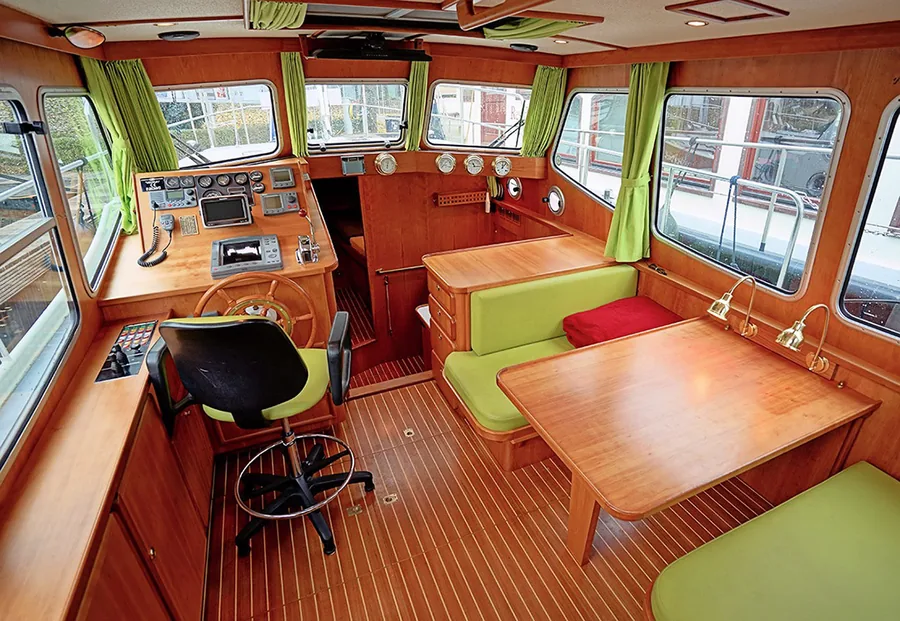
Photo: Werft 52
Anyone who lives aboard, even if only at weekends and on holiday, soon notices what is not right. The pump that starts up every time someone reaches for the tap and wakes the whole saloon. The toilet that is too loud. The steps to the aft deck that turn awkward the moment you carry something. Shipping has its own word for the work that changes all of this: refit.
On its page on restoration and conversions, Werft 52 AG explains the term like this: a refit is the renovation of a yacht entirely according to the wishes of its owner. It can be a partial renovation that concerns only the electrics, for example, or a complete overhaul. The yard on the Swiss shore of Lake Constance carries out this work in steel, in GRP and in wood, and sums up the scope in a single sentence: almost anything is possible, from a technical upgrade to an aesthetic refinement.
It starts with a list
A refit does not begin with a catalogue but with the things that get in the way of daily life aboard. On its website Werft 52 lists the questions owners bring to the yard, and they read like a log of everyday life. A freshwater pump that makes too much noise whenever the tap is used. Toilets that are too loud. A canopy that causes trouble when it is closed. Fenders that get in the way when they are stowed. No door to the bathing platform, a bathing platform that is too narrow, an uncomfortable staircase to the aft deck.
Then there are the technical reasons: a yacht that is too slow, outdated switchgear, a boat that cannot make headway against waves and wind or against the current of a river. The yard invites owners to share their experience and promises the right solution for each of these points.
For living aboard, this order is where the real gain lies. A saloon does not become more comfortable because the cushions are new if the pump hums at night. Anyone planning a refit does best to write down first what bothers them day to day, and only then what it should look like.
The saloon: a room for the whole day
The large picture above this text shows a saloon from the yard's refit work, fitted out entirely in warm wood. The helm station with its wooden wheel and instruments sits right next to the seating. The upholstery is light green, and so are the curtains; a large table stands in front of the bench, and two gold coloured reading lamps hang on the wall. Windows all round, and below them a wooden floor with light seams.
It is a room in which people steer, eat, read and spend the evening without having to move. That is exactly the task of a refit in the saloon: to bring wood, upholstery, light and technology together so that the room works from morning until night.
The bathroom: quiet is the real luxury
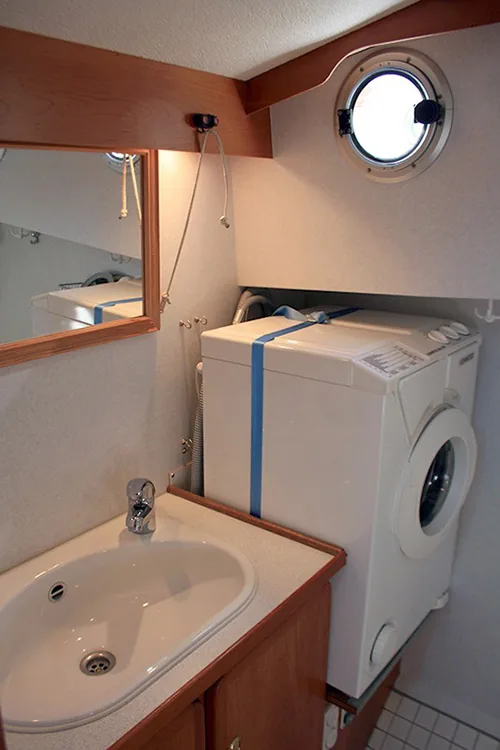
The bathroom shows how practical a refit can be. In one of the yard's pictures a washbasin with a wooden vanity unit, a mirror in a wooden frame, a porthole and a washing machine still secured with its blue transport straps share a small space. Finding room aboard for an appliance like this is a question of space, water and power, which is why it belongs in a plan that keeps the whole boat in view.
The bathroom is also where two of the owner wishes that Werft 52 names explicitly come together: a quieter freshwater pump and quieter toilets. Both sound like details, yet they decide whether there is peace aboard at night.
The galley: mahogany and a light worktop
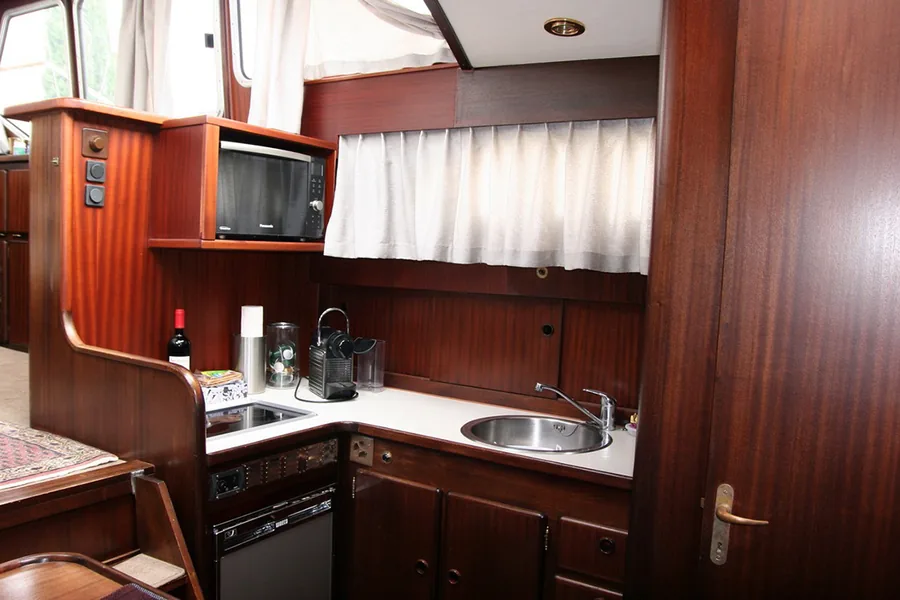
The galley in another picture is fitted out in dark mahogany. A light worktop holds a round stainless steel sink and a hob; above it a microwave sits in its own compartment, below it a fridge, and beside it drawers and doors in the same wood. A white curtain hangs in front of the window. In very little space there is everything a dinner aboard needs, and the wood ties the kitchen to the rest of the interior.
Steps, aft deck and the way into the water
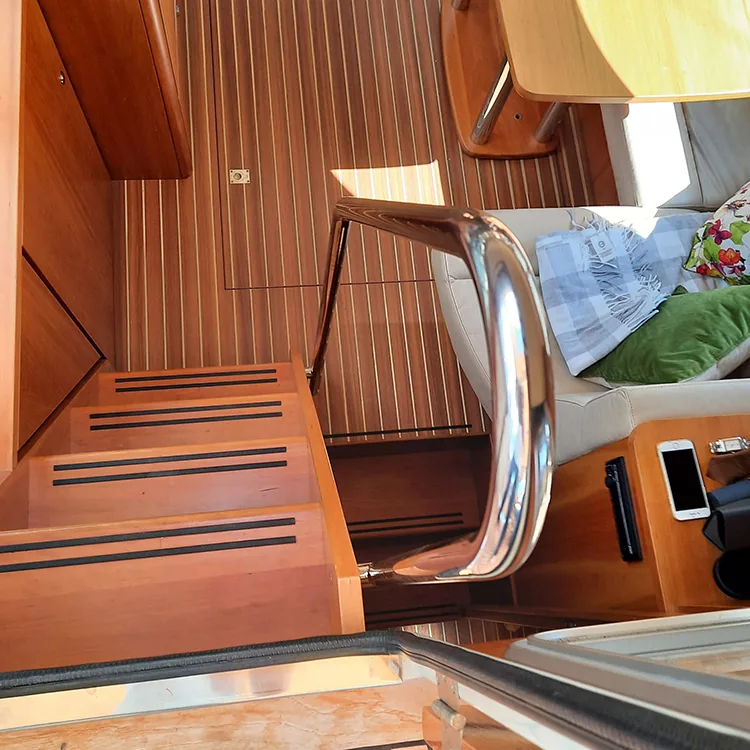
Living aboard also means a lot of up and down. Among the points Werft 52 lists are a more comfortable staircase to the aft deck, a door to the bathing platform and a wider bathing platform. A picture from the refit work shows a staircase into the interior: teak steps with dark non slip strips and a curved stainless steel handrail, with the saloon and its striped wooden floor opening up below.
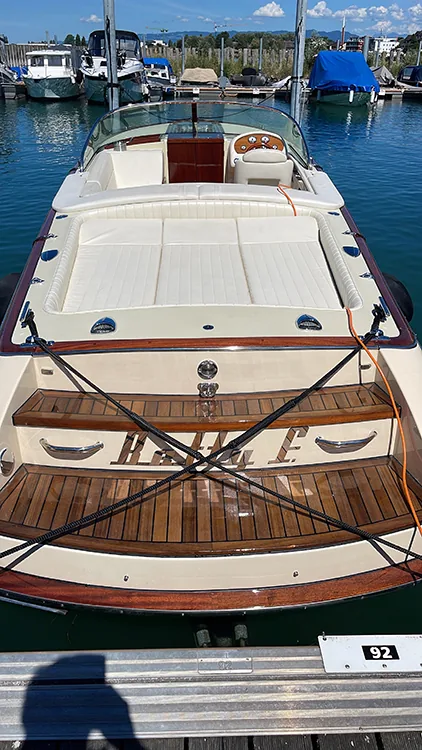
Another picture looks down on the stern of a motorboat at the jetty: a large sunpad with light upholstery, and towards the water steps and surfaces in teak. On a summer day the aft deck and the bathing platform are where most of the living happens, and it is no coincidence that several points on the yard's list are found exactly there.
What you do not see: electrics and the bare shell
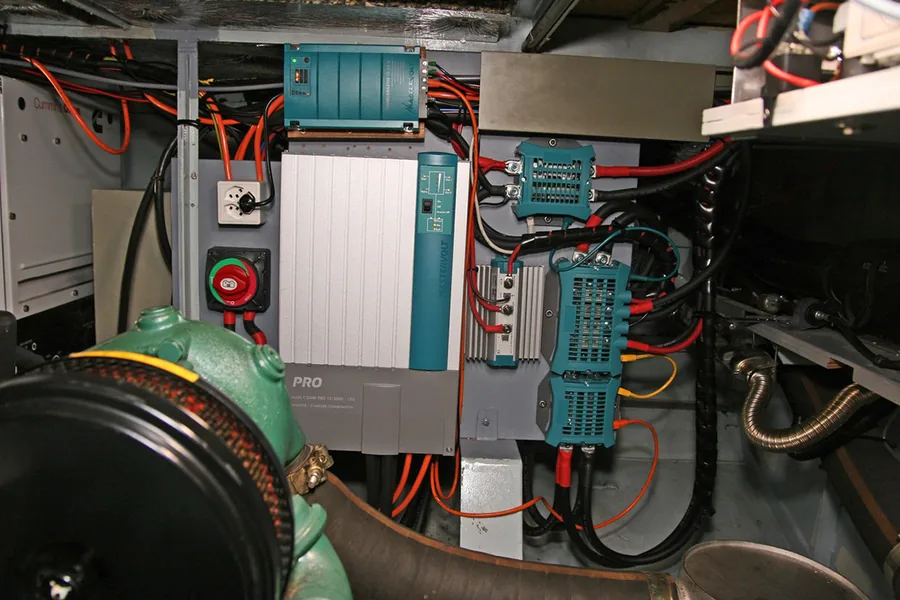
A refit can also be almost invisible. The partial renovation that concerns only the electrics is the example the yard itself gives, and outdated switchgear is one of the reasons owners come. A picture from the engine room of a yacht shows new electrics: a combined inverter and charger on the wall, a red battery main switch, distribution blocks under covers, the cables in red and black bundled and neatly routed, with the engine right beside them.
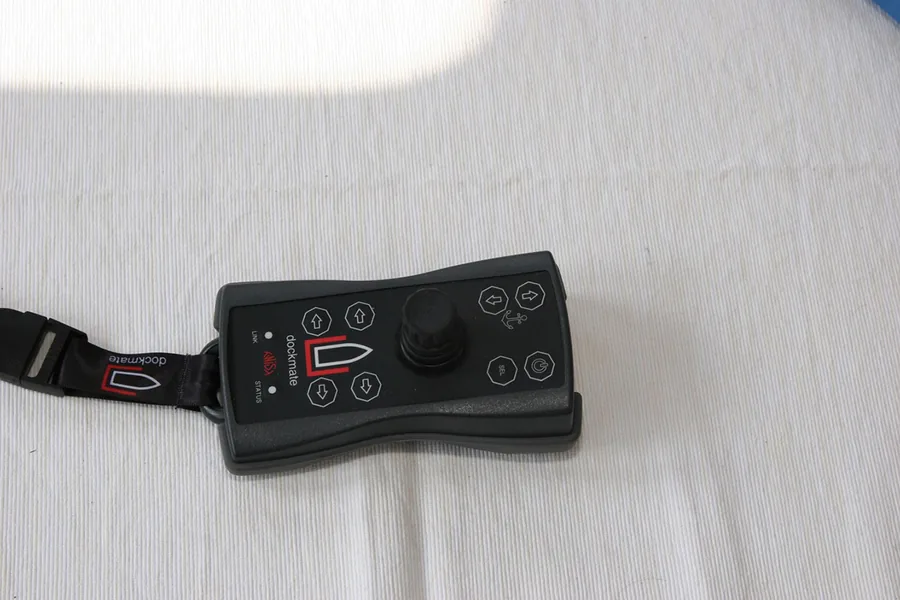
The pictures also include a wireless remote control with arrow keys, a rotary knob and a lanyard. It stands for the part of a refit that has nothing to do with wood and upholstery and still changes daily life aboard.
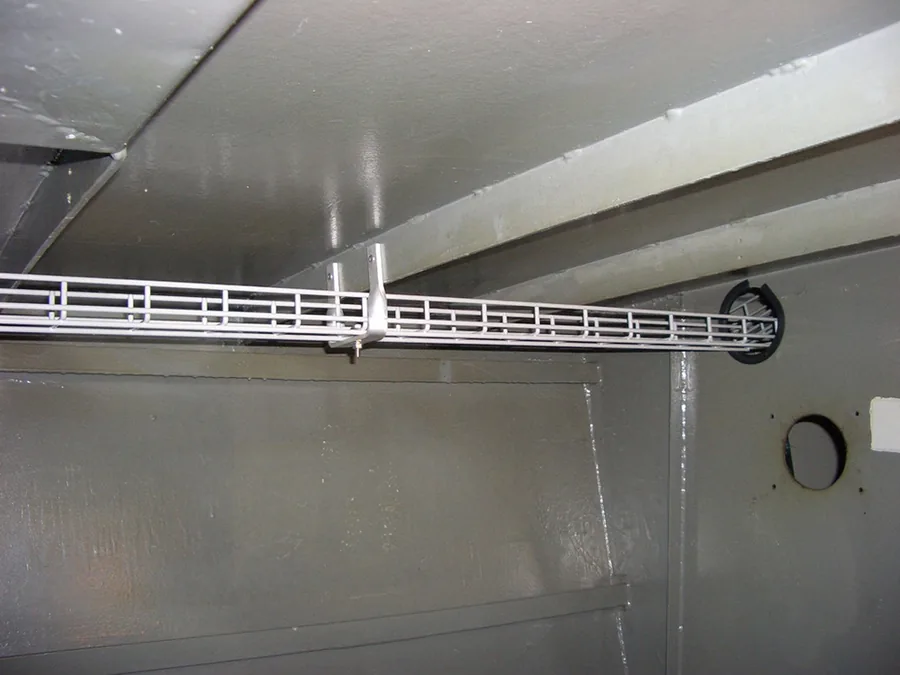
And then there is the phase an owner rarely gets to see: the bare shell. One picture shows an interior in which nothing has been lined yet. Walls and frames are painted grey, there are openings for lines in the wall, and a metal cable tray is already fitted under the ceiling. Whoever later steps into a finished saloon is standing on the result of work like this.
Boatbuilder and painter on site
That Werft 52 carries out refits in steel, GRP and wood has to do with the people on site. The yard has its own boatbuilder and its own boat painter right on the premises, plus a crane for up to 20 tonnes and a modern transport system that moves the yachts around the grounds. For the engines, specialised service technicians work on Mercruiser, Mercury, Volvo Penta, Steyr and Nanni. Wood, paint and technology come together in one place.
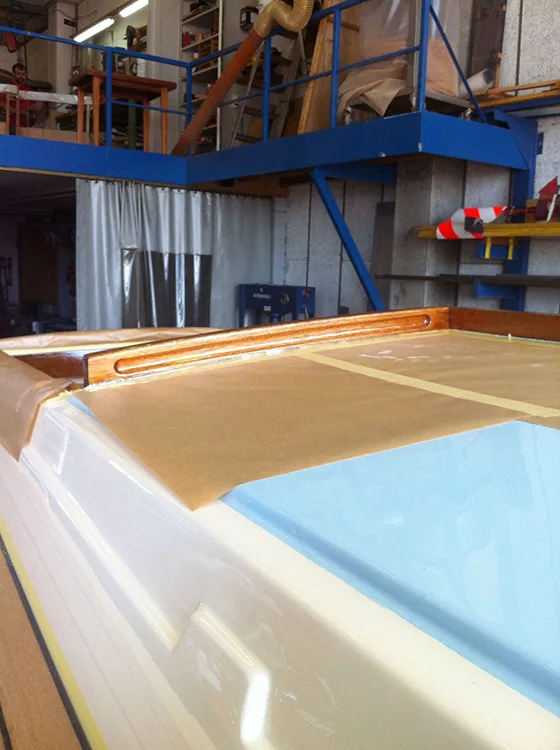
A picture from the workshop shows a superstructure whose surfaces are covered with paper and tape, a wooden handrail on top, and the blue gallery of the hall in the background. The work takes place at two sites: in Romanshorn, the headquarters for motorboats, with a heated workshop of 350 square metres, and in Kreuzlingen, the site for sailing boats, with 450 square metres of workshop. On its website the yard counts more than 15 refit projects and more than eight restorations.
The drive belongs to it too
Anyone who thinks about the electrics aboard often ends up at the drive. Werft 52 is a dealer for ePropulsion and Mercury Avator and offers complete conversions, retrofits and service for electric propulsion. For a boat you live on, a quiet drive is the logical continuation of a quiet pump.
At the end of a good refit there is a boat that adapts to its owner rather than the other way round. On the water as on land, that is the finest definition of living well.