Water
The pool you look at
You swim in it for six weeks and look at it for fifty-two. Design it for the looking.
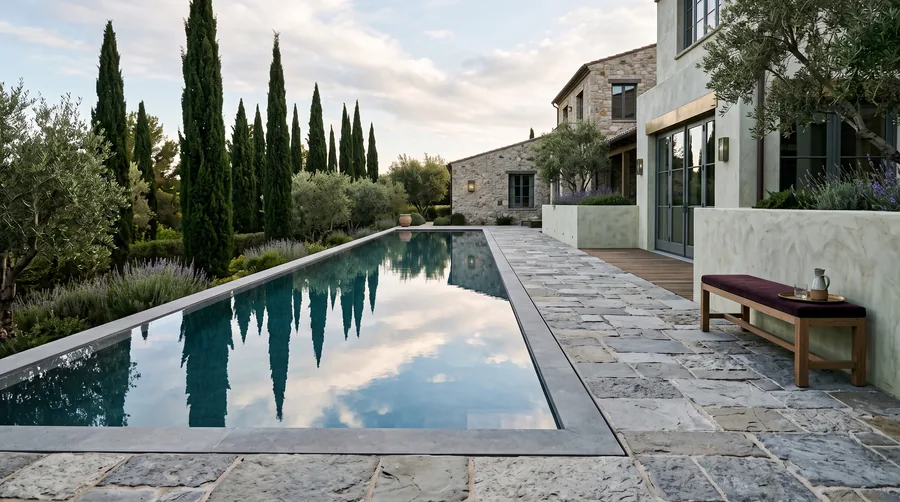
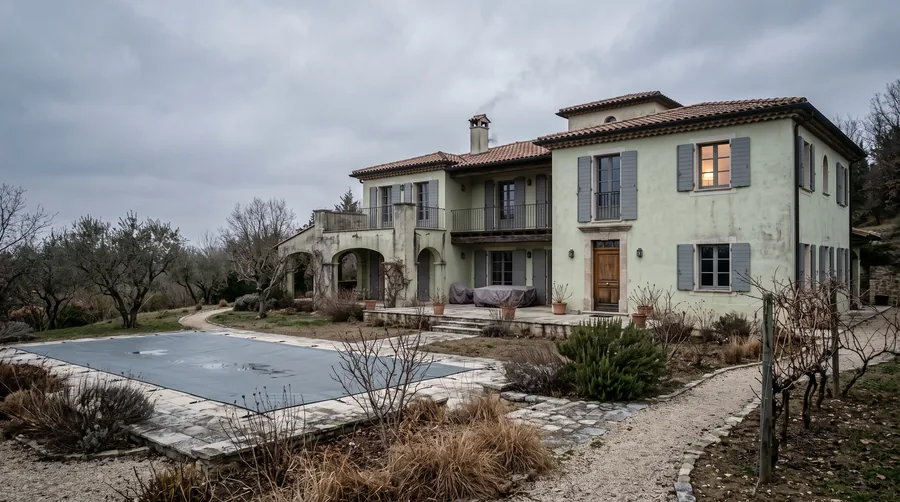
A pool is the largest single object in most gardens and the one chosen with the least thought about how it looks empty, in November, from the window of the room you spend the winter in.
The colour of the water is a decision
Water has no colour. What you see is the lining, filtered through depth. The same pool with four different finishes gives four completely different gardens, and the choice is usually made from a sample the size of a postcard.
Proportion, and the tyranny of the rectangle
Most pools are built at a ratio of about two to one because that is what the catalogue offers. A pool at three to one or four to one, narrower and longer, does three useful things: it is better to swim lengths in, it costs less to run per metre of visual effect, and it reads as a line in the garden rather than as a large blue box.
A 4 by 12 metre pool holds a third less water than a 6 by 12 and looks longer. On a sloping site the narrow pool is also considerably cheaper to build, which is the rare case of the better-looking option being the less expensive one.
Infinity edges, honestly
An infinity edge works when there is something behind it at a lower level to disappear into: the sea, a valley, a lower terrace. It requires a balance tank, a second pump, more water treatment and a higher running cost, and it will be off whenever the wind is above about twenty knots because the spill becomes spray.
On a flat site with a hedge behind it, an infinity edge is an expensive way to make the pool slightly harder to maintain. A deck-level pool with the water flush to the stone gives most of the same drama on any site, and it is the detail that makes water look like it was always there.
The cover argument
An automatic slatted cover costs between eight and eighteen thousand euro installed. It reduces evaporation by about ninety per cent, heating demand by fifty to seventy, chemical use by roughly half, and it keeps the leaves out, which is most of the daily labour. On a heated pool in southern Europe it pays for itself in three to five years and then keeps paying.
It also solves the November problem: a covered pool is a pale rectangle rather than a green one, and the garden looks intentional for the eight months nobody swims.
What a pool actually costs to run each year, by share
Use it now
Running Costs
What a house in the sun costs every year once it is finished.